Your Napoleon gas insert has been installed. Here's what to know.
1It's remote controlled
Your insert runs from a handheld remote with a built-in thermostat. Watch this short video to learn how to operate it.
How to Operate Your Remote Thermostat
2Smoke during the first few hours is normal
For the first couple of hours of burning, you may see visible smoke, and some may drift into the house. That's natural: the oils and paints from the factory are curing and burning off, so don't be alarmed.
Ventilate your home as needed (open a window or two) and avoid breathing it in.
3Electronic ignition: keep fresh batteries in
Your insert lights with an electronic spark. Normally the spark comes from household power. In a power outage you can still light it, as long as the receiver has four fresh AA batteries.
How to get to the batteries
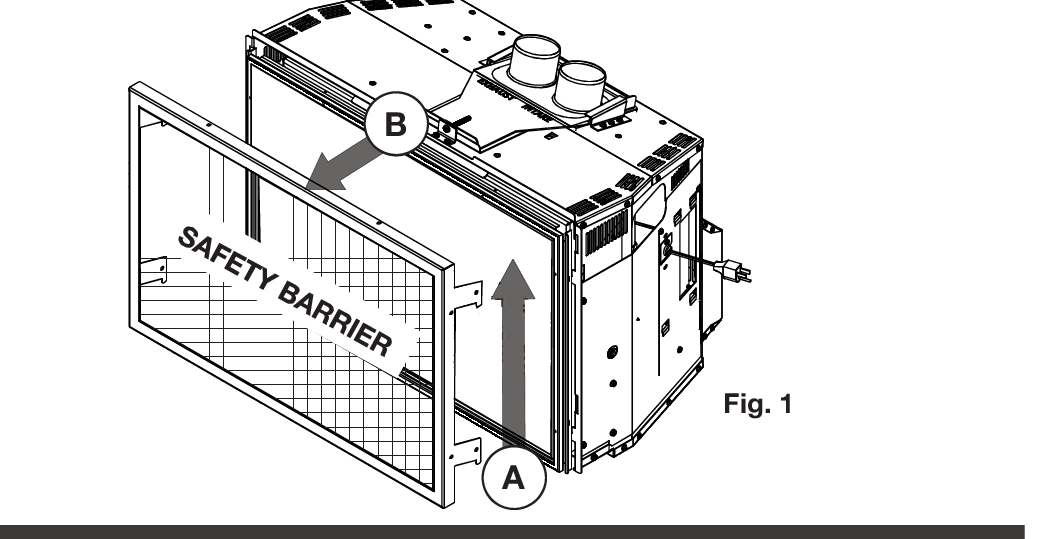
Remove the faceplate (safety barrier). Lift it up and out, tilting the top towards you, and set it aside.
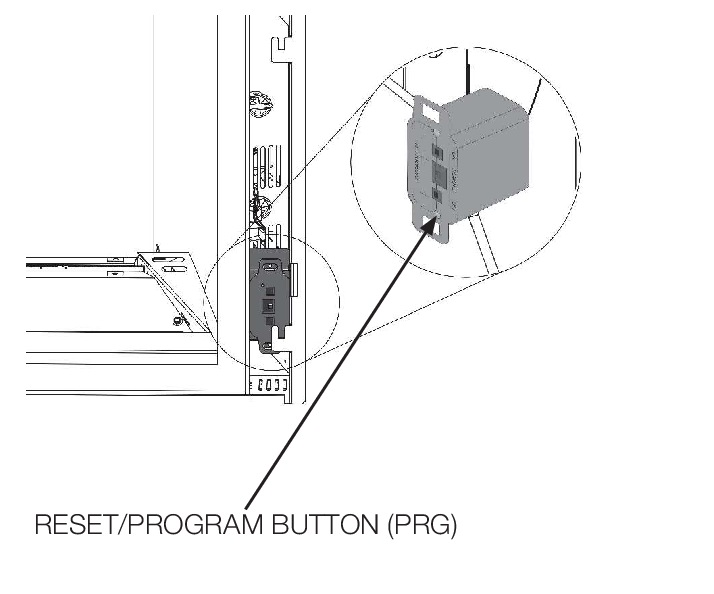
On the lower right side, next to the glass, you'll see the small receiver box with a slider switch.
Undo the upper and lower tabs and slide them away. The battery compartment comes out. Four AA batteries sit inside.
Replace the batteries once a year (we do this for you at your annual service). Then put everything back together.
Lift the faceplate (safety barrier) up, then tilt it toward you and away.The receiver box, lower right next to the glass. The reset/program button (PRG) is at the bottom right of the box.
Illustrations from the Napoleon Oakville series manual.
If the remote stops talking to the fireplace
Make sure the slider switch on the receiver box is in the center position.
Press the program (PRG) button, in the lower right corner of the box. You'll hear three beeps.
On the remote, press ON. You'll hear three beeps again, which means the remote and receiver are talking.
Press ON once more. The flame should start.
Dead batteries or a dead remote? Sliding the switch up to ON turns the fireplace on by hand. Return it to the center position afterwards so the remote works again.
That's all you need to know. Enjoy your fire! 🔥
Additional information: CPI vs IPI mode
CPI (Continuous Pilot Ignition) means your pilot light stays on constantly, even when the main flame is not on.
IPI (Intermittent Pilot Ignition) means your pilot is lit only on demand, to ignite the main burner right after you turn the fireplace on.
Why would I ever use CPI mode?
In some areas you may need CPI mode for the fireplace to work properly. This has to do with low outdoor temperatures and/or high humidity, and with chimney height and location.
When your pilot stays on in CPI mode, it pre-heats the inside of the firebox and helps remove excess moisture that could otherwise interfere with pilot ignition in IPI mode.
CPI mode keeps the exhaust pipe slightly pre-heated. The warmed air rises naturally and combats the heavy cold air that constantly tries to enter the pipe, so when the main flame comes on, its fumes can follow an upward draft that is already established.
In IPI mode, the main flame's fumes may struggle to exit through a column of cold air sitting in the pipe, and the flame can "choke" on its own fumes. You may see the main flame start up and die several times within the first few minutes. It may eventually succeed, but if it doesn't, the control may go into "lock-out" mode and need to be reset (unplugged from power for a few minutes) before it will try again in IPI mode. To avoid all this, switch to CPI mode.